Kadeem Hardison and Darryl M. Bell Launch ‘A Different World View’ October 15
Kadeem Hardison and Darryl M. Bell premiere their Black Effect rewatch podcast October 15, with Debbie Allen as the first guest.
Pat McAfee Takes Personality-Driven Alternate Coverage to the Super Bowl
Pat McAfee announces Field Pass coverage for selected Monday Night Football games and Super Bowl LXI; the first NFL edition is October 19.
PBS Stations Gain France 24 as an International-News Streaming Option
PBS member stations can offer France 24 English on PBS.org and the PBS app under an optional new streaming agreement.
Beau Bowman Takes Morning Traffic Duties at KCCI in Des Moines
Beau Bowman joins KCCI’s morning team as traffic anchor in Des Moines, Iowa. The station announced the assignment October 8.Source: KCCI announcement.
Ikegami’s Exposure Upgrade Offers Broadcasters Another Option Before Replacing Cameras
MAHWAH, New Jersey — Ikegami’s UHK-X700VN camera will be featured at the National Association of Broadcasters, or NAB, Show New York on October 21–22, acco
Timberwolves Bring 15 Free-TV Games to Four More Minnesota and Wisconsin Markets
Gray Media’s agreement with TEGNA and DAZN extends 15 free Timberwolves telecasts to Rochester, Duluth, Mankato and La Crosse–Eau Claire.
Sinclair Takes Local News to Substack—Will Subscription Revenue Reach the Newsrooms?
BALTIMORE, Maryland — Sinclair and New Media are preparing to turn local reporting into a national subscription product called The National Press, the companies announced October 6.
Jim Bakker, ‘PTL Club’ Televangelist, Dies at 86
Lori Bakker confirmed the television evangelist died October 5. The family’s announcement did not disclose a cause of death.
Chris Wayland to Succeed Valari Staab at NBCUniversal Local
NBCUniversal Local names Chris Wayland its next president as Valari Staab prepares to retire at year-end.
WHYY Saves WPSU—Now Its New General Manager Must Build a Sustainable Future
Fred Vigeant starts October 26 as WPSU’s general manager following WHYY’s completed acquisition. The next test is sustainable funding and local service.
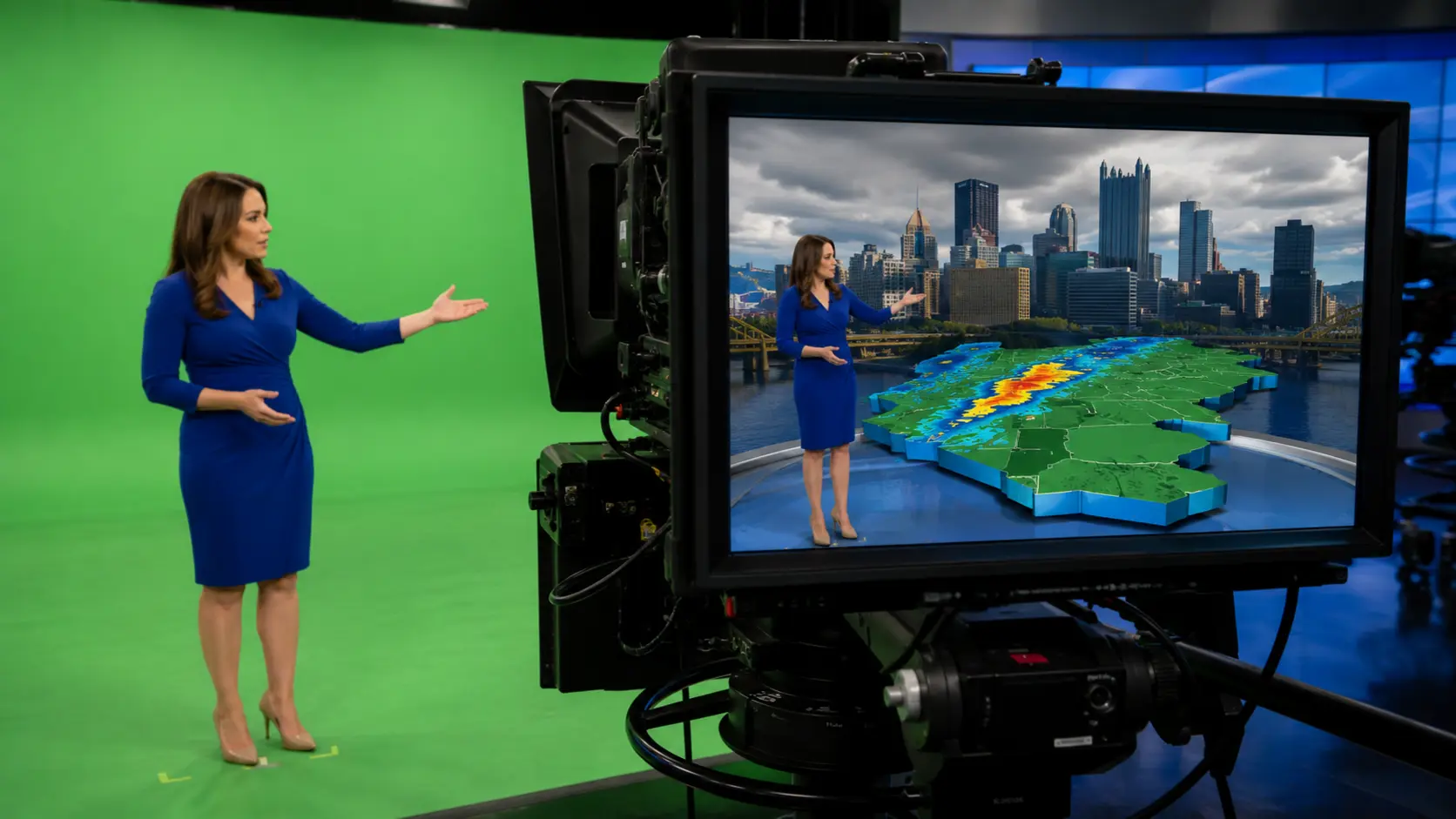
CBS Pittsburgh is rebuilding part of KDKA-TV’s existing Gateway Center facility as an augmented- and virtual-reality news studio, bringing a production system already used in other CBS markets to one of the company’s best-known local stations.
CBS said the project will include large green-screen surfaces and a fully virtual environment in which anchors, meteorologists and reporters can interact with computer-generated scenes and graphics in real time.
That description can make the studio sound more mysterious than it is. Here is the simple version.
AR and VR without a headset
Viewers at home will not put on virtual-reality goggles.
In augmented reality, the system places a computer-generated object—such as an election map, a storm track, a sports statistic or a life-size chart—into what appears to be the physical studio. The presenter can stand next to it, point to it and move around it.
In virtual reality, most or all of the environment seen by the viewer is created by a graphics engine. The anchor may be standing on a green floor in front of green walls, while the television picture shows a courthouse, a hurricane path, a football field or a three-dimensional model.
Camera tracking is the key. The graphics system must know precisely where the camera is, which direction it is pointing, and whether it is zooming. It then redraws the virtual scene fast enough to preserve the illusion that the graphics and presenter occupy the same space.
Why build it inside a local station?
An in-house system makes immersive production available for daily news rather than only for a network special or an outside production company.
A weather team can walk viewers through the height of a flood. An investigative reporter can explain the path of money through several companies. An election presenter can move between counties and voting blocs. A sports anchor can place a player’s performance inside a full-size virtual field.
Once the station builds and approves a graphic environment, it can update the data and use the template repeatedly. CBS has also been deploying similar systems across its owned-station group, creating the possibility of sharing technical knowledge, software and graphic assets among markets.
CBS Sacramento became the company’s 12th newsroom to adopt the format in May 2026, using it for news, weather and sports. CBS Pittsburgh’s project continues that wider strategy.
The technology does not replace the journalism
AR and VR can clarify a complicated story, but they can also become an expensive distraction.
The most effective use begins with one question: What can the viewer understand here that a conventional camera shot or full-screen graphic would not show as clearly?
Stations also need rules that distinguish illustration from reality. A virtual reconstruction must be labeled. Scale should be accurate. Dramatic imagery should not exaggerate risk. Staff members need training in writing, blocking, timing and operating the system—not simply in generating eye-catching visuals.
There are operational demands, too. Green-screen lighting must be even. Camera tracking must remain calibrated. Graphics have to render without delay. Producers need a fallback if the system fails seconds before air.
What radio can learn from it?
This is a television installation, but the lesson is relevant to radio operators moving into visual media.
“Visual radio” does not have to mean pointing a single camera at a host for three hours. A modest version can combine tracked cameras, data graphics, remote guests, sponsor elements and short explainers designed for social platforms. The full CBS system may be beyond an independent operator’s budget, but the production logic is scalable.
The real product is not the virtual set. It is a newsroom that can turn a difficult subject into a picture the audience understands.
CBS initially said the Pittsburgh studio was expected to launch later in 2026. Radio News Now will update this report when KDKA confirms its on-air debut and publishes final