
By Lee Michaels
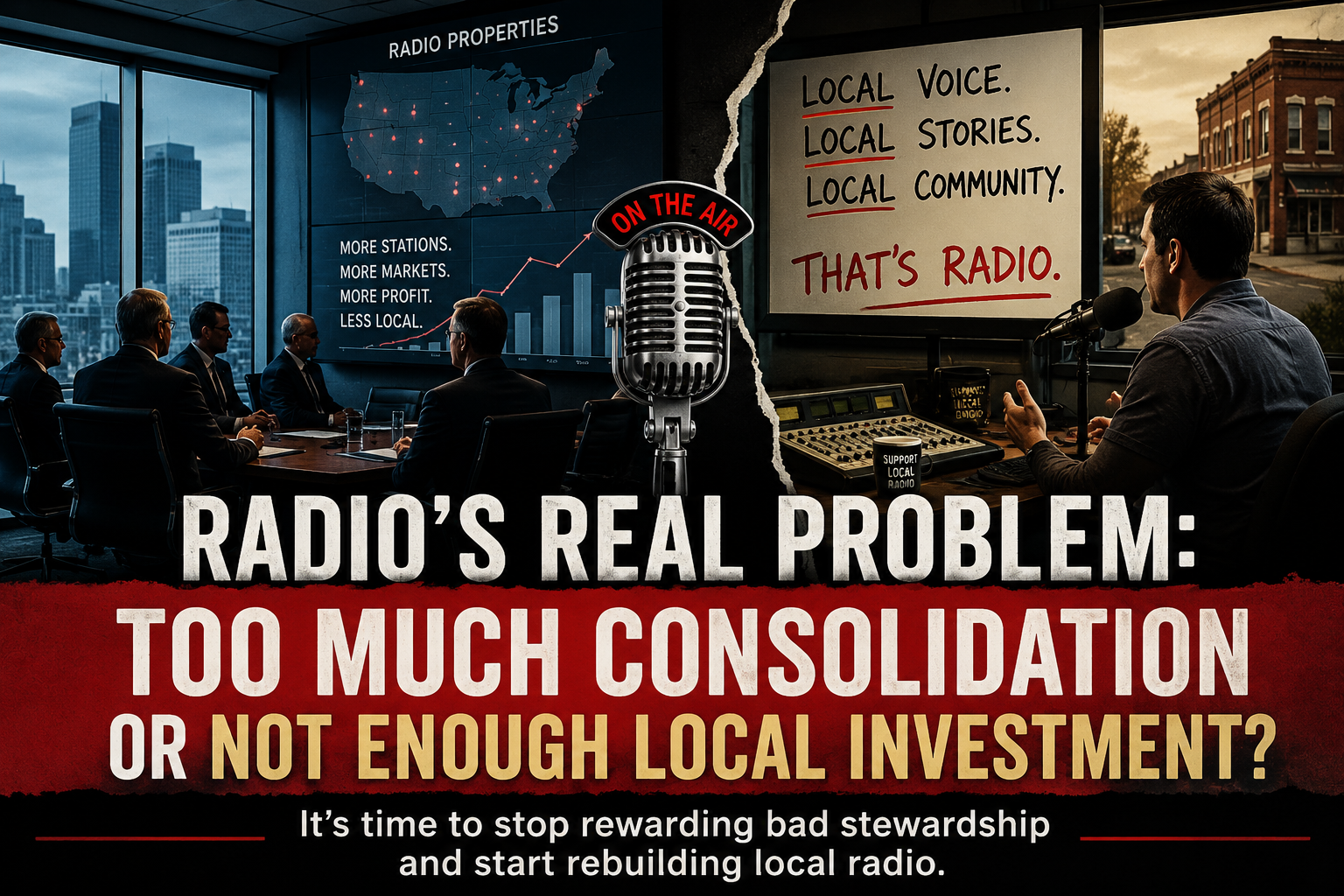
Radio does not have a consolidation problem because the industry was never allowed to consolidate enough.
Radio has a consolidation problem because too many of the companies that were allowed to consolidate did not know how to operate what they bought.
That may sound harsh, but after decades in this business, I believe it is the truth.
When consolidation first opened the door for major groups to buy stations across the country, the promise was efficiency, stronger operations, better resources, and a more competitive radio industry. In theory, larger companies would have the money, talent, technology, and discipline to build stronger stations and serve local communities better.
That is not what happened.
What happened instead is that too many radio companies became financial machines first and broadcasting companies second. The people making the biggest decisions were often not broadcasters. They were investment bankers, lenders, debt managers, and corporate financial operators. They controlled the purse strings, and the programming people, promotion people, sales people, engineers, local managers, and air talent had to operate within decisions made by people who often did not understand the emotional connection between a radio station and its audience.
Radio is not just towers, licenses, spreadsheets, debt service, and quarterly reports.
Radio is a local trust. Radio is personality. Radio is community memory. Radio is the morning show that knows the streets. It is the night jock who understands the music. It is the program director who can feel a market. It is the sales manager who knows the local business owners. It is the station that shows up when something happens in town.
You cannot run that from a spreadsheet.
For more than 20 years, many of the largest companies have had the opportunity to prove that bigger ownership automatically creates better radio. In too many cases, they have proven the opposite. We have seen layoffs, voice tracking, regionalized decision-making, reduced local programming, thinner staffs, fewer local promotions, and market managers asked to oversee more properties than any one human being can realistically manage well.
At some point, we have to stop pretending this is a strategy.
A general manager, regional vice president, or operations executive cannot effectively run eight, nine, ten, eleven, or twelve stations in a market with the kind of attention each brand deserves. Every station has its own audience, culture, competitive position, talent needs, revenue challenges, and community responsibility. When everything is centralized, something important gets lost.
Usually, what gets lost is local radio.
Now, the same ownership groups and advocates want more rules relaxed so companies can buy even more stations. The argument is that radio needs greater scale to compete with Google, Meta, streaming platforms, podcasts, satellite radio, and other digital competitors vying for audience and advertising dollars.
I understand the competitive pressure. It is real.
But giving more stations to companies that already failed to fully serve the stations they own is not modernization. It is rewarding bad stewardship.
If the big operators could not properly manage what they already had, why should the answer be to give them more?
The real solution may need to go in the opposite direction.
Instead of allowing more consolidation, perhaps regulators and industry leaders should be asking how to get more stations back into the hands of local owners, real broadcasters, community-minded operators, and entrepreneurs who actually want to build radio stations — not just manage assets.
If a company bought too many stations, loaded them with debt, cut the local staff, weakened the brands, and lost money, then maybe the market correction should be simple: sell some of those properties at realistic prices. Not fantasy prices based on old multiples. Not inflated values from the consolidation boom. Real prices. Haircut prices. Prices that allow new owners to come in, invest, hire, rebuild, and reconnect.
That would be a healthier reset than simply relaxing the rules again and hoping the same people produce a different result.
Radio’s problem is not that it lacks scale.
Radio’s problem is that it has lacked enough true broadcast leadership in the rooms where the major decisions are made.
I have been in some of those rooms. I have heard how those decisions get discussed. Too often, the conversation was not about the audience, the music, the community, the talent, or the brand. It was about debt, margins, cost reductions, consolidation, and financial engineering.
That approach did not pan out in their wildest dreams.
Radio cannot cut its way back to greatness. It cannot debt-manage its way back to relevance. It cannot automate its way back to trust. And it cannot keep asking for more consolidation while ignoring the damage that consolidation has already done.
The future of radio depends on investment, but not just financial investment.
It needs investment in people. Investment in programming. Investment in local content. Investment in sales training. Investment in community presence. Investment in research. Investment in music discovery. Investment in young talent. Investment in experienced broadcasters who know how to build stations that matter.
Radio needs operators who understand that a station is not simply a license. It is a living brand.
Yes, the industry must compete with digital platforms. Yes, advertising has changed. Yes, technology has changed. Yes, AI will change even more. But none of that changes the core truth: radio wins when it is local, trusted, entertaining, useful, and emotionally connected.
That kind of radio is not created by giving distant owners more properties to manage from farther away.
It is created by putting responsibility back into the hands of people who know the market, respect the audience, understand the music, and believe the station exists for more than debt service.
The question is not whether radio needs more consolidation.
The question is whether radio is willing to admit that consolidation, as practiced by many of the biggest players, did not deliver what was promised.
If we truly want a stronger radio industry, we should stop rewarding the same failed playbook. We should encourage local ownership, responsible investment, real broadcast leadership, and market-level accountability.
Radio does not need another round of kicking the can down the road.
Radio needs a reset.
And that reset should begin with a simple principle: if you cannot properly serve the stations and communities you already own, you should not be asking for the right to own more.
There is another concern here that cannot be ignored: influence.
The same large companies and trade groups that have the money, lobbyists, political relationships, and access to decision-makers are usually the ones with the loudest voices in Washington. That does not automatically mean every argument they make is wrong. But it does mean regulators should be careful not to confuse corporate convenience with the public interest.
We are living in a moment when government, finance, technology, and major corporations are becoming more intertwined than ever. In the technology sector, there are already reports of unusual government arrangements involving chip companies and discussions about potential government stakes in major AI firms. Whether someone supports or opposes those ideas, the trend is clear: big business wants government partnership when it benefits big business.
Radio should not follow that same path without serious public scrutiny.
If the largest radio groups already had decades to prove that more ownership equals better local service, and if the result has been fewer local voices, thinner staffs, weaker community presence, and more centralized decision-making, then the FCC should not simply accept the argument that those same companies need even more control.
The question should not be, “How much more can we let them own?”
The question should be, “What did they do with what they were already allowed to own?”
If the answer is debt, layoffs, automation, and reduced local service, then the solution is not more consolidation. The solution is accountability, local investment, and a serious path for more stations to return to local or truly broadcast-minded ownership.
#radio
#consolidation
#nab
#fcc
#localradio