
By Lee Michaels
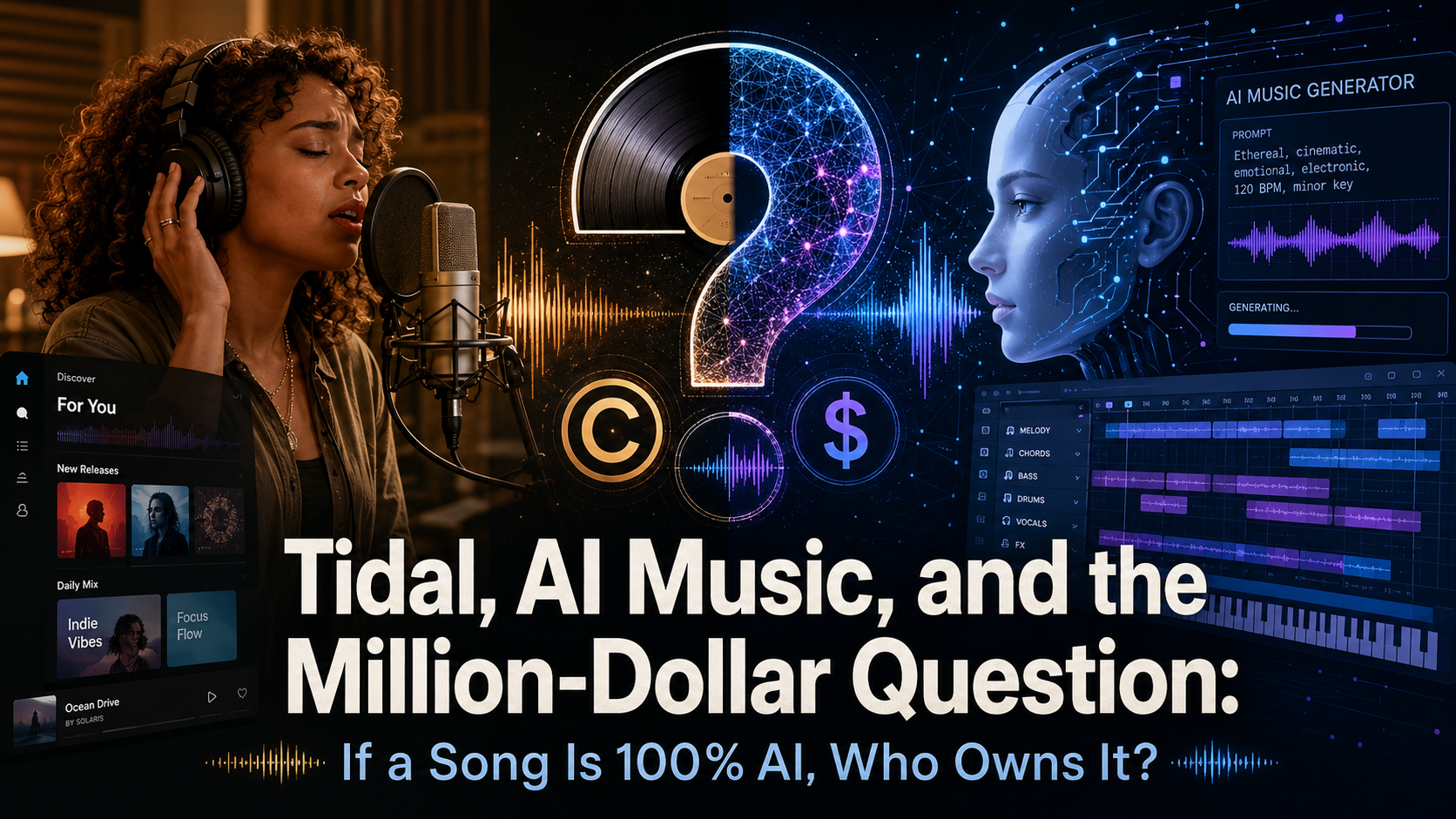
Tidal has taken one of the strongest public positions yet on AI-generated music, and the decision raises a much bigger question than whether a song should carry an AI label.
The real question is: if a song is 100% AI-generated, who owns it?
Tidal’s new policy does not ban AI music outright. Instead, the platform says it will accept AI-generated music as long as it meets the company’s standards, terms, and agreements with rights holders and distributors. Beginning in mid-July, Tidal says listeners will see an icon next to music the company identifies as 100% AI-generated. The company also says distributors will be expected to identify AI-generated content before it reaches the platform.
But Tidal is drawing a hard line on money.
The company says 100% AI-generated music will not be monetizable. In plain English, that means no royalties for wholly AI-generated tracks and no direct-to-fan sales for uploads Tidal believes are entirely AI-generated. Tidal says its priority is making sure royalties go to original works directly produced, written, and performed by people.
That is where the industry conversation gets serious.
Tidal Is Not Saying “No AI.” It Is Saying “No Royalties for 100% AI.”
There is a major difference between banning AI music and refusing to pay royalties on it.
Tidal is not saying artists cannot use AI tools. The company’s own policy says artists should have the freedom to create with AI tools, and listeners should have the freedom to choose what they consume. But Tidal is also saying AI-generated content will be held to a higher standard, especially when it involves impersonation, fraud, high-volume uploads, fake activity, or music that deceives listeners.
That puts Tidal in a new position. It is not acting only as a streaming service. It is becoming a gatekeeper over how AI-generated music is labeled, distributed, and monetized.
That may be necessary. It may also become complicated.
If a Song Is 100% AI-Generated, Who Owns It?
Under current U.S. copyright guidance, a work created entirely by AI, without meaningful human authorship, may not qualify for copyright protection.
The U.S. Copyright Office says generative AI outputs can be protected only when a human author determines enough of the expressive elements. Human-written lyrics, a human-created melody, a human vocal, a human arrangement, or meaningful human editing may be protectable. But simply typing a prompt is generally not enough.
That creates a huge problem for AI music.
Suppose someone types: “Create a three-minute R&B ballad about heartbreak, with a smooth male vocal, a dramatic bridge, and a radio-ready chorus.”
The AI generates the lyrics, melody, vocals, track, arrangement, and mix.
Who owns that song?
The person who typed the prompt may have permission from the AI company to use it, depending on the service’s terms. But permission to use something is not the same as owning a copyright. If the song is truly 100% AI-generated, there may be no copyright owner at all under current U.S. rules.
That is the part many people miss.
The AI Company’s Terms Do Not Automatically Create Copyright
AI music companies may give users commercial rights, but that does not automatically mean copyright exists.
For example, Suno’s terms say paid Pro or Premier subscribers receive Suno’s rights in outputs Suno owns, but Suno also says it does not guarantee that copyright will vest in any output. Suno also warns that AI outputs may not be unique and that the service may generate the same or similar output for another user.
That means an AI company can say, “You may use this commercially,” while the law may still say, “There may not be a protectable copyright in the purely AI-generated parts.”
That distinction matters.
If there is no copyright, the person who paid for the AI tool may not be able to stop someone else from copying the song, re-recording the song, or releasing something very similar — unless there are other legal issues involved.
And there often are.
Example One: The Fully AI Song
Let’s say a user creates a song entirely with AI. No human lyrics. No human melody. No human vocal. No human playing. No human arrangement beyond a prompt.
That song may be usable under the AI company’s terms, but it may not be copyrightable as a human-authored musical work.
If Tidal detects it as 100% AI-generated, Tidal says it will label it and block it from monetization.
That means the creator may be able to upload it, but not earn Tidal royalties from it.
Example Two: AI-Assisted, But Human-Created
Now let’s say a songwriter writes the lyrics, creates the melody, sings the lead vocal, and uses AI for a background track, a drum idea, or a production texture.
That is a different situation.
The human-created elements may still be copyrightable. The lyrics, melody, vocal performance, arrangement, and production decisions may contain enough human authorship to qualify for protection. The AI-assisted portions may need to be disclosed or limited in a copyright claim, but the human contribution can still matter.
That is why “AI-assisted” and “100% AI-generated” should not be treated as the same thing.
Example Three: The Record Label Question
Here is where it gets even more interesting.
What is the relationship between Tidal and record labels?
Tidal is a streaming platform. Labels and distributors deliver music, metadata, and rights information to the platform. Tidal says it provides regular payment reporting to distribution partners, and that the distributor or label is responsible for delivering royalty data and disbursements to the artist.
Tidal also says it may receive music-related data from labels and distributors when they send music for publication, and that it may share certain data with content rights holders to calculate and report streaming numbers and royalties.
That does not mean record labels automatically get private access to every AI-generated track sitting inside Tidal’s system. Based on Tidal’s public materials, the relationship appears to be about licensing, delivery, metadata, reporting, and payment — not giving labels a secret pipeline to harvest AI songs.
But the concern is still worth asking.
If a song is 100% AI-generated and not copyrightable, could a label hear it publicly, have one of its artists re-record it, make human modifications, and then claim ownership in the new version?
The uncomfortable answer is: possibly, depending on the facts.
If the original AI song has no protectable human authorship, then the underlying AI-generated composition may not have a copyright owner in the traditional sense. A human artist who rewrites the lyric, changes the melody, creates a new arrangement, performs the vocal, and records a new master may own copyright in the human-created parts of that new version.
But that does not mean everything is automatically safe.
The new version could still create legal risk if the AI output copied protected elements from an existing human song, used a cloned voice, imitated an artist’s name or likeness, violated an AI company’s terms, or included human-created elements from the original user that were actually copyrightable.
In other words: 100% AI may sound like a free-for-all, but it is not a clean free-for-all.
The Major Labels Are Already Moving Toward Licensed AI
This debate is not theoretical anymore.
Universal Music Group settled a copyright dispute with AI music company Udio and announced plans to collaborate on AI products using authorized and licensed music. Reuters reported that Universal, Sony, and Warner had sued Udio and Suno in 2024, alleging mass copyright infringement from training AI systems on label-owned recordings.
Pitchfork reported that the UMG-Udio agreement includes a licensing framework for UMG sound recordings, songs, and publishing assets, with participating UMG artists and songwriters to receive compensation for AI training and outputs.
That shows where the industry may be headed.
The major labels do not appear to be walking away from AI. They are trying to control it, license it, monetize it, and protect their catalogs from being used without permission.
That is a very different business model from the open, prompt-based AI music explosion we have seen so far.
The Bigger Industry Issue
Tidal’s decision may be the beginning of a new standard.
Streaming platforms have spent years paying royalties based largely on ownership claims, distributor metadata, and consumption. AI music creates a new problem: what happens when millions of tracks are generated by machines, uploaded at scale, and possibly streamed by bots or fake listener activity?
Tidal is saying those tracks should not drain money from the royalty pool that was built to compensate human artists, songwriters, producers, musicians, labels, and publishers.
That is a powerful statement.
But it also raises difficult questions:
Who decides whether a song is 100% AI-generated?
What happens when an artist uses AI for only part of the song?
Can detection technology keep up?
Will distributors be required to certify AI use?
Will record labels create their own licensed AI catalogs?
Will “verified human-made music” become more valuable?
And most importantly: will independent artists be protected, or will the major rights holders control the next version of the music business?
My Take
Tidal is making a necessary move, but this issue is far from settled.
The music industry needs three separate lanes:
First, human-created music should be protected, promoted, and paid.
Second, AI-assisted music should be clearly disclosed, but not automatically punished when meaningful human creativity is involved.
Third, 100% AI-generated music should be labeled honestly, and platforms have every right to decide whether that content should receive royalties.
The danger is not simply that AI can make music. The danger is that AI can flood the market with music-like content, confuse listeners, dilute royalty pools, and create a new ownership gray area where no one knows who really controls the song.
Tidal has now forced the conversation into the open.
And the question every artist, label, distributor, and streaming platform must answer is simple:
If no human truly created the song, should the music business pay it like a human did?