
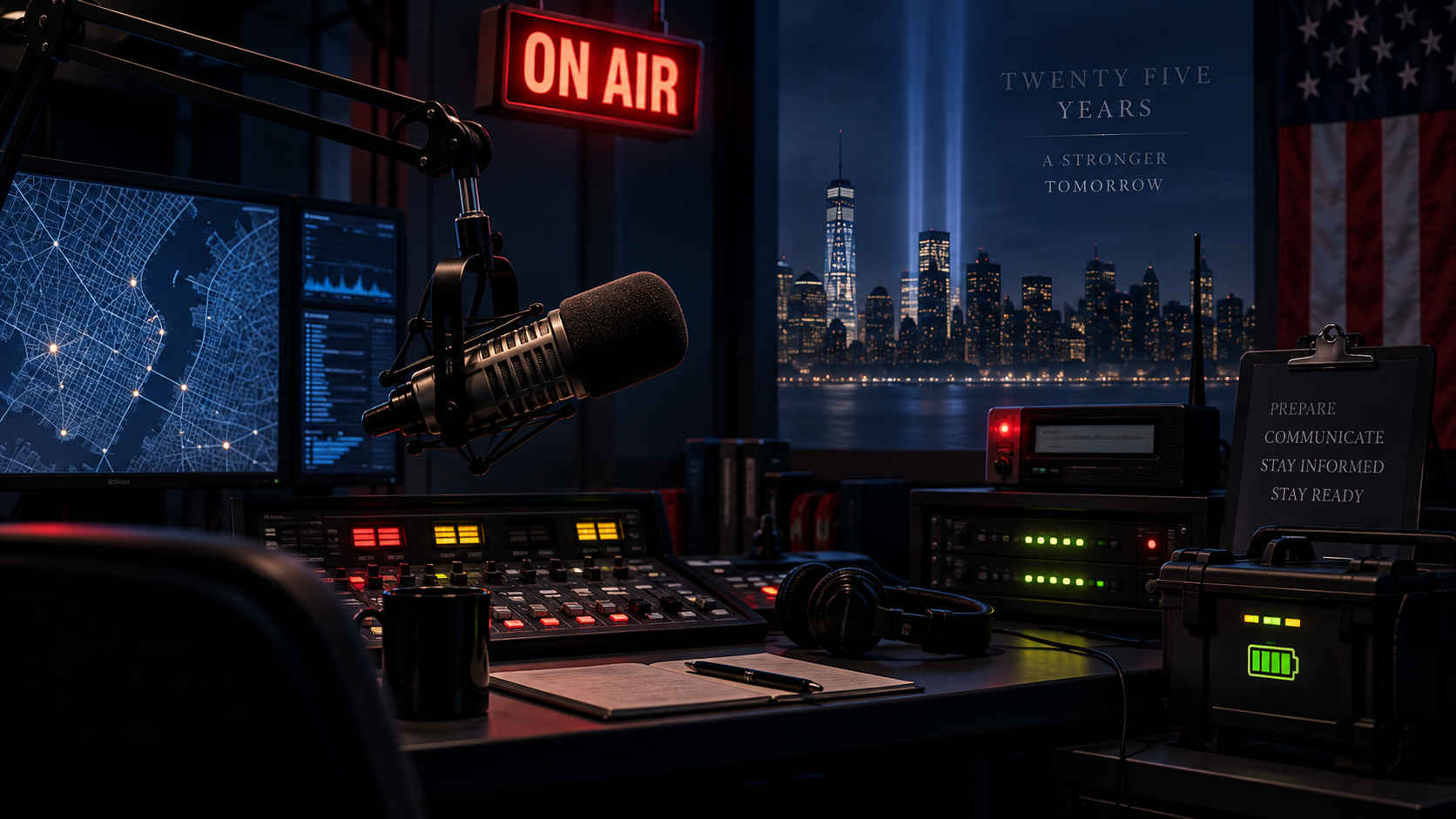
Twenty-five years after the September 11 attacks forced broadcasters to abandon normal formats and become emergency lifelines, Radio News Now is asking a direct operational question: are today’s stations actually prepared to do it again?
On September 11, 2001, stations across the country stopped music, suspended commercial schedules, carried television audio, opened telephone lines and attempted to make sense of rapidly changing events. The strongest operations relied on experienced local employees who could make decisions without waiting for a distant corporate chain of command.
Radio remains uniquely valuable during emergencies, but the systems behind it have changed. Many stations now depend on IP audio, remote automation, cloud services, shared technical personnel and consolidated newsrooms. Those tools can make operations efficient, yet they also create new points of failure.
Emergency readiness is more than a working transmitter
A station can remain on the air and still fail its community. Meaningful readiness requires the ability to verify information, interrupt automation, reach local authorities, originate programming and continue operating when power, internet service or a network feed disappears.
Every station should be able to answer these questions before an emergency begins:
- Who has the authority to suspend ordinary programming immediately?
- Can local staff take control if automation or a remote network becomes unavailable?
- How long can the studios, transmitter and essential networking equipment run on backup power?
- Are Emergency Alert System devices protected by unique passwords, current software and appropriate network controls?
- Are local emergency-management, police, fire, hospital and utility contacts current?
- Can reporters transmit dependable audio when cellular networks are congested?
- Is there a verified plan for simulcasting television or another radio service?
- When was the complete plan last tested under realistic conditions?
The FCC is considering a more secure alerting system
The Federal Communications Commission is examining modernization of the Emergency Alert System and Wireless Emergency Alerts. Its proposals include stronger authentication, standardized alert identification and cybersecurity improvements intended to make false or manipulated alerts harder to inject.
Technology cannot substitute for judgment. Authentication may help confirm where an alert originated, but a station still needs trained people capable of explaining what the warning means locally, correcting misinformation and staying on the air when normal systems fail.
Local responsibility cannot be automated away
The anniversary should not be treated only as a historical remembrance. It is an opportunity for broadcasters to conduct an honest readiness audit and correct failures while there is still time.
Radio News Now is asking stations, engineers and emergency managers to share the practical lessons they have learned from drills, disasters and real outages. We will examine backup power, staffing, field equipment, EAS security and the ability of local broadcasters to remain accountable when their communities need them most.
Sources: Radio Ink’s September 8 retrospective; FCC alerting-modernization fact sheet; FCC Emergency Alert System overview