
Radio News Now Staff
Updated August 5, 2026: KCAL management has provided two facts that materially sharpen this story.
The station says its previous format was not profitable.
It also says the new presentation is not using AI-generated voices.
Those facts should be stated clearly because the real story is strong enough without exaggeration.
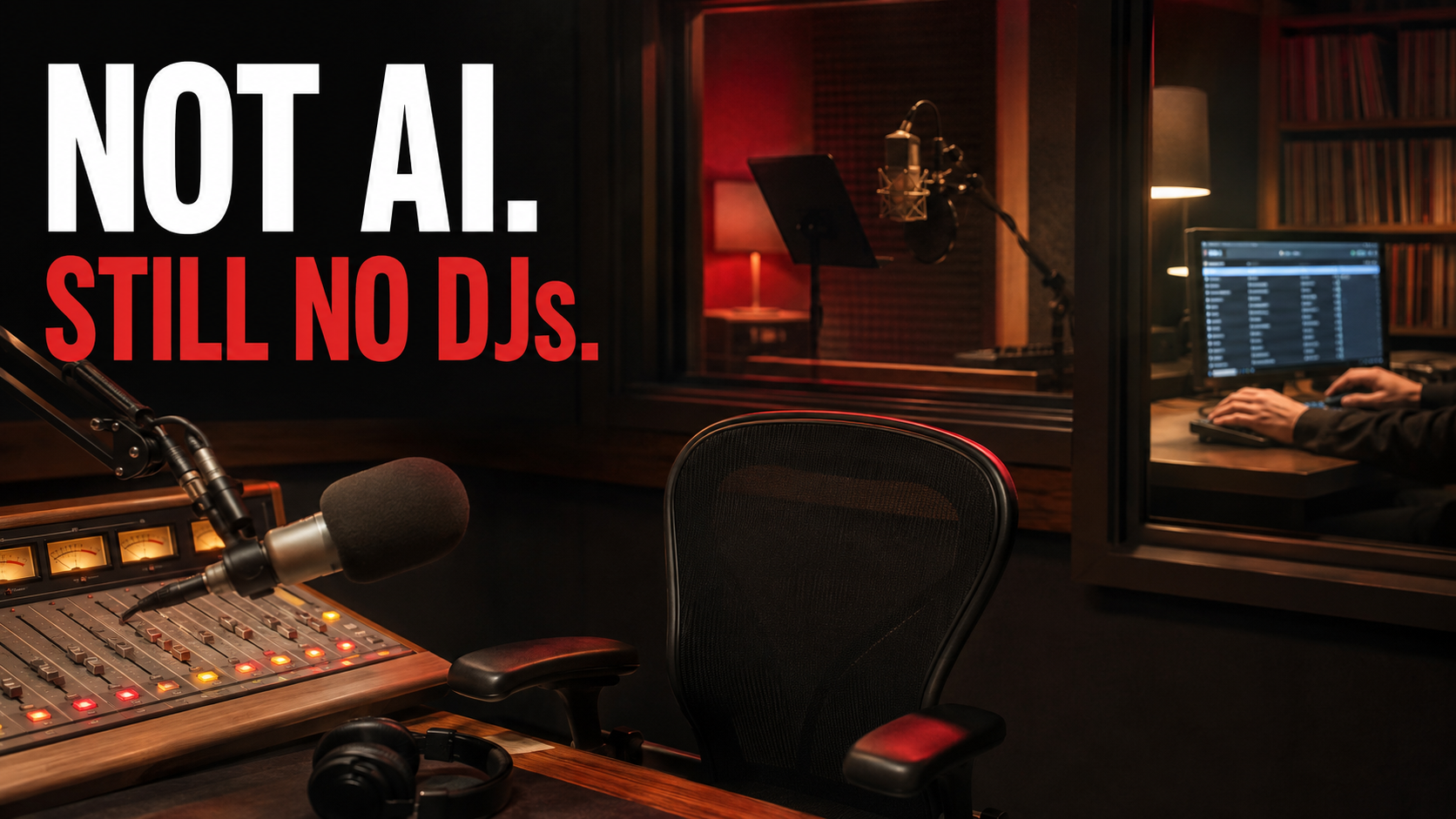
KCAL-FM 96.7 has eliminated its entire full-time, part-time and weekend air staff and moved to an “All Music, All the Time” classic-rock format. But the station has not turned music selection and imaging over to artificial intelligence. Program Director Gary Springfield told SFGATE that professional voice talent produces the station imaging and real people continue to curate the music.
KCAL is now a DJ-less radio station. It is not an AI-voiced radio station.
The people behind parts of the product remain. The personalities who had daily relationships with the audience do not.
Management says the decision came down to financial reality
Springfield said KCAL faced changing listening habits, tougher competition for advertising and rising operating costs. His blunt conclusion was: “Bottom line, KCAL wasn’t profitable.”
That is the most important new information in the story.
A station cannot indefinitely operate a format that loses money. Employees, listeners and advertisers may hate the decision, but ownership still has to pay salaries, music licenses, facilities, insurance, transmission costs and every other expense required to keep the station operating.
Radio News Now does not dismiss that financial reality.
But “unprofitable” describes the result. It does not, by itself, identify the cause.
Were the personalities the problem – or was the business around them failing?
Without KCAL’s internal ratings, revenue, expense and audience research, the public cannot know whether the personality product caused the losses.
Other possibilities deserve examination:
-
Was the music strategy competitive?
-
Was the station marketed aggressively enough?
-
Did the sales department convert audience loyalty into endorsements, events and digital revenue?
-
Was the commercial inventory priced and packaged effectively?
-
Did operating costs rise faster than revenue?
-
Was the audience aging or moving to other platforms?
-
Were the personalities supported with video, podcasts, social media and community appearances?
-
Did management test less destructive changes before eliminating every host?
-
Was the format itself unprofitable, or was this version of the format unprofitable?
Those are not excuses for keeping a losing operation unchanged. They are the questions a serious diagnosis requires.
If a restaurant is losing money, firing every server may reduce payroll. It does not prove that table service caused the losses.
KCAL still uses human work – just not human companionship on the air
The AI clarification matters because “automated” and “AI-generated” are not the same thing.
Radio has used automation systems, voice tracking, recorded imaging and scheduled music logs for decades. A computer can play the next element without generating the voice, choosing the song or pretending to be a person.
KCAL says human professionals still create the station’s imaging and music flow. That makes the new format a low-personality, highly automated presentation – not a fully synthetic one.
The business question remains unchanged: What value disappeared when the personalities did?
The departed staff included veteran hosts, part-timers and weekend fill-ins. Daryl Norsell said he spent 42 years at the station, including 36 in afternoon drive. Steve “Razz” Brazill described KCAL as part of his identity after a relationship with the station dating to 1987.
Those decades represented more than talk between songs. They included listener familiarity, community presence, endorsements, appearances and institutional memory.
KCAL has decided that the cost of that human connection exceeded the value it was producing under the old model.
Now the station must prove the new equation works.
“More music” enters a competition streaming already dominates
KCAL’s new promise is focused classic rock with fewer interruptions and broader appeal to listeners and advertisers.
That may improve certain listening occasions. Some people genuinely prefer long music sweeps without conversation.
But Spotify, Apple Music, YouTube Music, Pandora and personal playlists already offer more music, deeper catalogs and individualized control. A local station cannot out-catalog a global streaming platform.
Radio’s strongest differentiation has traditionally been what streaming does not automatically provide: companionship, local knowledge, humor, emergency presence, community conversation, live events and trusted voices.
KCAL is reducing the part of the product that was hardest for streaming to duplicate and emphasizing the part streaming already supplies in abundance.
That does not guarantee failure. It does make the strategy a high-value test for the entire radio industry.
The no-jock strategy needs a scoreboard
KCAL’s former format was not profitable. The next question is whether the replacement becomes profitable – and at what cost to the brand.
Radio News Now will watch:
-
Audience ratings and time spent listening
-
Advertising revenue and advertiser retention
-
Commercial load and the actual number of interruptions
-
Website, app and social-media engagement
-
Concert, promotion and community visibility
-
The use of endorsements and local sponsorships
-
Any return of live or recorded personalities
-
Whether savings produce sustained profitability
If revenue stabilizes, audience grows and advertisers respond, management will have evidence that the new model solved a business problem.
If payroll falls but audience connection, advertising value and market relevance fall with it, the station may become less expensive without becoming more competitive.
Local personality radio is not cleared – or convicted – by one bottom line
KCAL’s financial explanation deserves to be included, and its AI clarification deserves to be respected.
The station was losing money. The new format is not using AI voices. Those are facts.
But neither fact proves that local personalities are obsolete.
It proves that KCAL’s previous business model was not working.
The difference matters because radio companies across the country are deciding whether people are an expense to remove or an asset they have failed to develop, market and monetize.
KCAL has chosen to remove the personalities and keep the human work behind the curtain.
Now the audience and the advertisers will determine whether that is enough.