
Lee Michaels | Radio News Now —
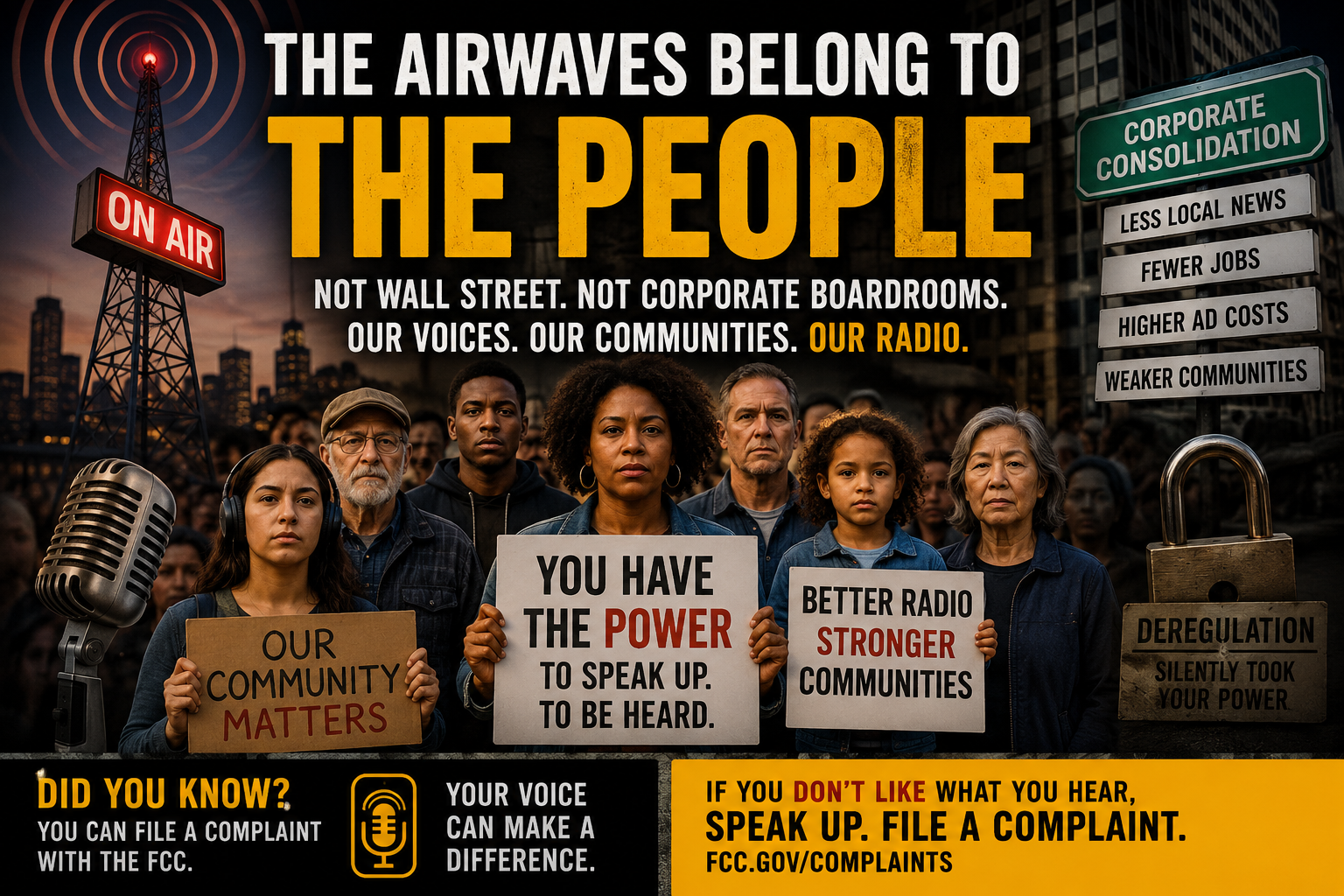
The radio industry is once again having a familiar conversation: should the FCC loosen broadcast ownership rules and allow companies to own and control even more AM, FM, and television stations?
The National Association of Broadcasters and many large station groups argue that the old rules are outdated. They say radio and television broadcasters are no longer just competing against each other. They are competing against Google, Facebook, YouTube, Spotify, Netflix, TikTok, satellite radio, podcasts, streaming platforms, and every digital advertising machine on the planet.
That part is true.
The media world has changed dramatically. Radio is no longer the only audio game in town. Local television is no longer the only video source in town. Advertisers now have more choices than ever. Consumers have more choices than ever. Broadcasters are fighting for audience, attention, advertising dollars, and relevance in a digital world.
But here is the question that must be asked before the FCC opens the door even wider:
Who really benefits if broadcasters are allowed to own more stations?
Is it the listener?
Is it the advertiser?
Is it the local community?
Or is it ownership?
I have been in this business long enough to remember what happened the last time the industry was deregulated and companies were allowed to buy more stations. I saw it coming then, and I see it again now.
The last great wave of deregulation promised stronger companies, better efficiencies, more competition, and better service. In too many markets, that is not what happened.
What happened instead was an ownership gold rush.
Companies started buying stations at inflated prices. One group would bid, another group would bid higher, and suddenly stations were being priced far beyond what their actual cash flow could justify. The cost of entry became ridiculous. The debt became enormous. The pressure to hit financial targets became brutal.
When you overpay for a station, you do not magically create more audience. You do not magically create more local revenue. You do not magically create more community connection.
You create debt.
And when debt becomes the real boss, radio changes.
The first thing to suffer is usually local service. Local news gets cut. Public affairs programming gets pushed to the side. Community issues receive less attention. Public service announcements become filler instead of commitment. Local personalities disappear. Local program directors lose authority. Decisions move from the market to the corporate office.
A radio station that used to be part of the neighborhood becomes part of a spreadsheet.
That is where the damage was done.
Radio was built on local trust. The best stations knew the mayor, the school board, the local churches, the neighborhood clubs, the high school teams, the concert promoters, the record stores, the barbershops, the community leaders, and the listeners by name.
When something happened in the city, the radio station knew because the station was part of the city.
Consolidation changed that in too many places.
Instead of investing in local talent, companies found ways to syndicate, voice-track, automate, and centralize. Instead of building deeper community relationships, many groups focused on cost-cutting. Instead of programming for the people in the market, they programmed for operating margins.
There were positives. We should be honest about that.
Larger ownership groups sometimes brought better technology, stronger sales systems, improved research tools, better engineering support, national advertising relationships, digital infrastructure, and the ability to keep struggling stations alive. In some cases, scale helped stabilize stations that might otherwise have failed.
For advertisers, larger groups could offer one-stop shopping. A business could buy multiple stations, multiple formats, digital products, streaming inventory, event sponsorships, and promotions through one sales organization. That convenience has value.
For broadcasters, scale can help when competing against digital giants that operate without the same local ownership limits. Google and Facebook can dominate local advertising without owning a single tower in the market. Spotify and YouTube can compete for audio attention without having to maintain local newsrooms, public files, towers, transmitters, emergency alert systems, or FCC licenses.
So yes, broadcasters have a legitimate argument when they say the competitive landscape has changed.
But the question is not whether the media world has changed.
The question is whether giving existing broadcasters more ownership power will fix what is wrong — or repeat what already failed.
Because the last time ownership limits were relaxed, the big promise was that scale would make radio stronger. Instead, in many cases, it made balance sheets bigger, debt loads heavier, and local service thinner.
Several of the largest radio companies eventually had to restructure or file bankruptcy. That tells us something. It tells us the problem was not simply that companies needed more stations. The problem was that many companies paid too much for the stations they already had and then tried to squeeze profits out of properties that could not support the debt.
That was not a programming strategy.
That was not a local service strategy.
That was financial engineering.
And local radio paid the price.
Listeners lost local voices.
Communities lost local coverage.
Employees lost jobs.
Advertisers lost some of the local creativity and market knowledge that made radio special.
Independent owners found it harder to compete.
And in many markets, the product became more predictable, more centralized, and less connected.
So when the industry now says, “Let us own more,” the FCC should ask a simple question:
What exactly did you do with what you were already allowed to own?
Did you invest in local news?
Did you strengthen public affairs?
Did you develop new local talent?
Did you serve underserved communities?
Did you create better opportunities for minority ownership?
Did you help advertisers grow with better local ideas?
Did you make radio more exciting, more local, and more essential?
Or did you cut staff, centralize programming, increase debt, and ask the public to accept less?
That is the heart of the issue.
More ownership is not automatically bad. But more ownership without stronger public-interest obligations is a bad idea.
If the FCC is going to consider relaxing ownership rules, then broadcasters should be required to show what the public gets in return. Not just shareholders. Not just lenders. Not just dealmakers. Not just corporate management.
The public.
If a company wants to own more stations in a market, then there should be real commitments attached:
More local news.
More local public affairs.
More emergency information.
More community partnerships.
More local talent development.
More transparent staffing commitments.
More opportunities for independent, minority, and community voices.
More proof that consolidation will serve the market, not just the owner.
Without that, we are not modernizing broadcasting. We are simply giving the largest operators more control.
And let’s be honest: the likely first beneficiaries of relaxed ownership limits would be the biggest station groups, investors, brokers, lenders, and companies looking to buy, sell, merge, or restructure assets. Advertisers may benefit from easier buying and bundled packages, but only if the stations still deliver real audience and local results. Listeners may benefit only if ownership uses scale to improve local service.
But based on history, listeners should be skeptical.
Advertisers should be skeptical.
Communities should be skeptical.
Because radio’s problem has never been that one company could not own enough stations.
Radio’s problem has been that too many companies forgot what made the business powerful in the first place.
It was not debt.
It was not consolidation.
It was not Wall Street.
It was not spreadsheet programming.
It was connection.
Radio worked because it was local, immediate, emotional, trusted, and human.
A great radio station could break a record, calm a city during a crisis, raise money for a family in need, introduce a new artist, sell out a concert, help a small business grow, and make listeners feel like somebody in the building actually knew them.
That is what deregulation weakened.
So before the FCC gives broadcasters more ownership freedom, it should ask for more than promises. It should ask for proof.
Proof that more ownership will create more service.
Proof that more control will not mean fewer local voices.
Proof that advertisers will get stronger results, not just bigger packages.
Proof that communities will get better radio, not just more stations under the same logo.
I will go on record and say it plainly:
Giving broadcasters more ownership power without requiring stronger local service is another bad idea.
We tried the ownership gold rush before. It inflated station prices, buried companies in debt, weakened localism, cost people jobs, and left too many communities with less radio than they deserved.
The FCC should not reward that history by pretending it did not happen.
If the industry wants more freedom, it should first make a stronger commitment to the public.
Because the airwaves do not belong to Wall Street.
They belong to the people.