
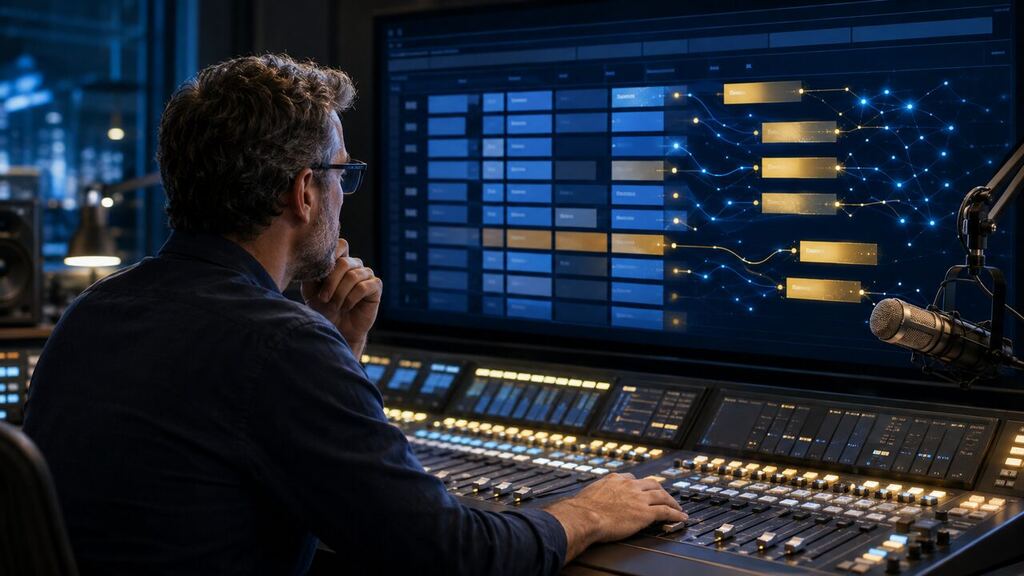
Artificial intelligence is moving into one of radio’s most consequential programming systems: the music scheduler.
RCS says it will debut RCSAI inside SelectorCloud at IBC 2026 in Amsterdam. The company describes it as the first application of RCS Intelligence, a new AI engine within its cloud ecosystem.
The limited preview does not yet establish exactly what RCSAI will decide, recommend or change. That distinction matters because a music scheduler influences repetition, artist separation, tempo, category balance, unfamiliar-song exposure and the overall flow listeners hear.
A programming tool, not merely a writing assistant
SelectorCloud already gives programmers browser-based access to library management, clocks, scheduling rules, log editing and analysis. Adding an AI engine to that environment could help identify scheduling conflicts and repetitive patterns—or could quietly standardize decisions across stations if the system’s authority is not clearly defined.
RCS says SelectorCloud provides advanced AI while preserving complete creative control. That is a manufacturer description, not yet an independently tested result.
Questions RCS should answer at IBC
- Recommendation or automation: Does RCSAI flag problems for a programmer, or can it revise and approve a music log?
- Reasoning: Can the music director see why a song was moved, rejected or scheduled?
- Control: Can every AI decision be overridden, and can the feature be disabled by station, format or daypart?
- Data: Does it rely only on a station’s rules and history, or also on audience, airplay and external market data?
- Audit trail: Does the system retain the original schedule, its changes and the identity of the person who approved them?
- Originality: What prevents different customers using similar settings from receiving increasingly similar logs?
- Cost and access: Is RCSAI included with SelectorCloud, sold separately or licensed by station or user?
The most useful test will be straightforward: give RCSAI and an experienced music director the same library, format clock and scheduling rules. Then compare repetition, artist separation, tempo flow, unfamiliar-title placement and the number of manual corrections each log requires.
AI may be capable of finding conflicts faster. It cannot define a station’s local personality or decide what promise the station wants to make to its audience unless programmers first supply a clear strategy. The technology should help execute the format—not become the format.
Sources: Radio World’s September 2 IBC preview; SelectorCloud product information. IBC 2026 runs September 11–14.