
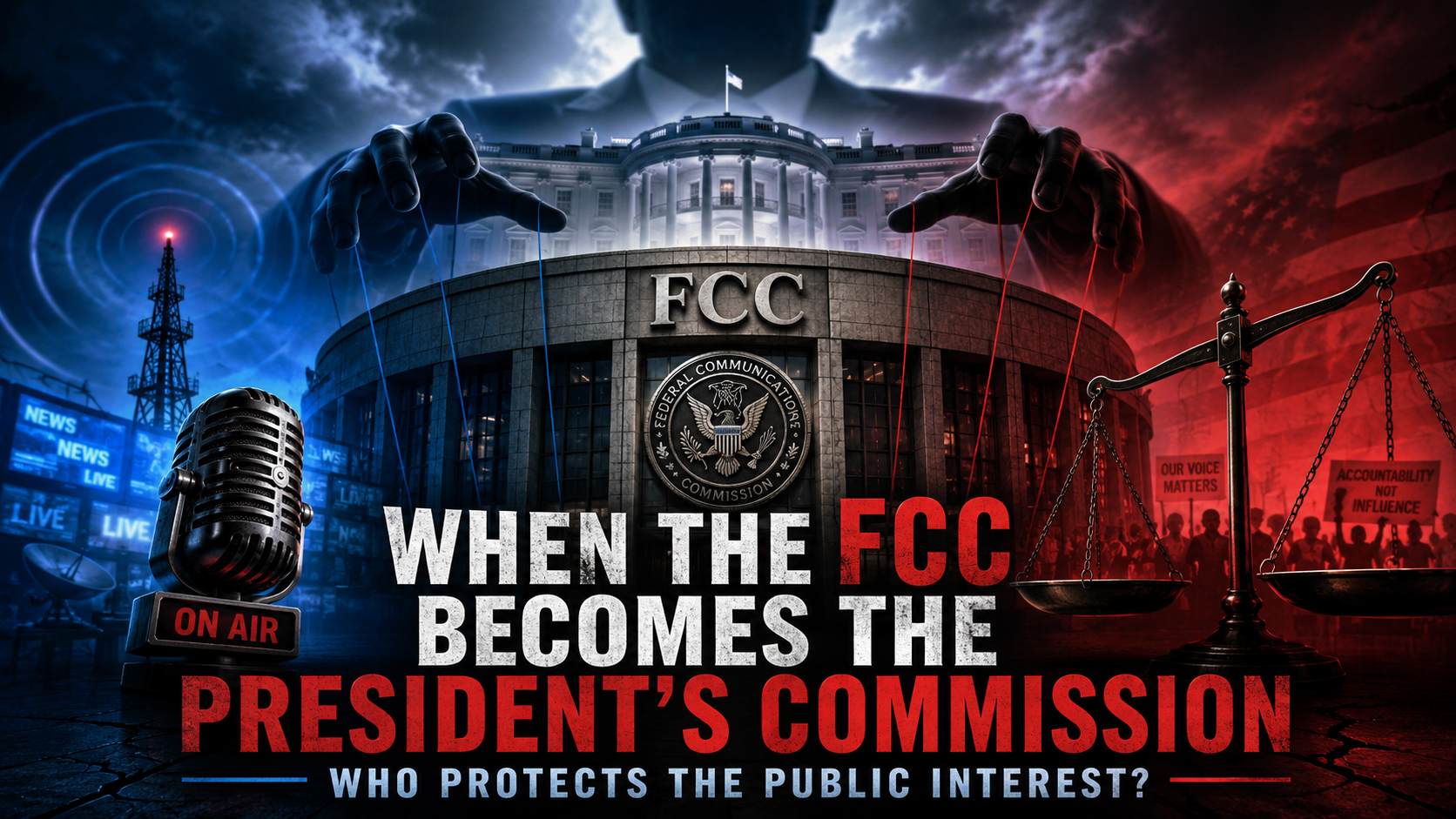
A Supreme Court ruling could weaken the political balance that was intended to keep the Federal Communications Commission from becoming an instrument of whichever party controls the White House.
Commentary by Lee Michaels
A recent Supreme Court decision involving the Federal Trade Commission could have consequences reaching far beyond that agency—and directly into the future independence of the Federal Communications Commission.
In Trump v. Slaughter, the Supreme Court ruled 6–3 that the FTC’s statutory protection preventing commissioners from being removed without cause violated the constitutional separation of powers. The decision strengthened presidential authority over officials who exercise executive power.
Although the case concerned the FTC, its reasoning could be applied to other federal regulatory agencies, including the FCC.
That should concern broadcasters, journalists, media companies, artists, consumers and anyone who believes communications policy should be guided by the public interest rather than party loyalty.
The FCC Could Swing With Every Administration
The FCC was designed as a five-member commission with staggered terms and limits on how many commissioners may belong to the same political party. Three commissioners are required for a quorum.
Those provisions were intended to create continuity and prevent one political party from exercising unlimited control over the agency.
However, the law establishes a limit on the number of commissioners belonging to one party. It does not guarantee that the opposing party will always have representation.
If a president can remove FCC commissioners at will, a future administration could potentially remove opposition-party members and replace them with commissioners who support its political and regulatory agenda.
The result could be an FCC operating without meaningful internal political balance.
A Republican administration could create a commission dominated entirely by Republicans. A Democratic administration could eventually do the same in the opposite direction.
That would mean communications policy could change dramatically every four years based on who occupies the White House.
This Is Bigger Than Party Politics
This concern is not about whether Republicans or Democrats should control the FCC.
It is about whether either party should have unchecked control over an agency with enormous authority over American communications and media.
The FCC influences:
- Broadcast ownership and consolidation
- Station licenses and license renewals
- Media mergers and acquisitions
- Political broadcasting requirements
- Sponsorship identification
- Payola and undisclosed promotional arrangements
- Localism and public-interest obligations
- Enforcement actions against broadcasters and communications companies
An agency possessing that much authority should not become a political weapon that rewards allies, pressures media companies or punishes critics.
The iHeartMedia Agreement Shows Why This Matters
We are already seeing why consistency and independence at the FCC are so important.
The FCC recently entered into a consent decree with iHeartMedia, resolving an investigation into whether artists received additional radio airplay in exchange for performing at company events.
Under the agreement, the FCC terminated its investigation and dismissed related complaints. iHeartMedia made no admission that it violated any law, regulation, or FCC policy, and the settlement did not require a monetary payment or fine.
Instead, the company agreed to establish a compliance program, train employees, disclose its anti-payola policy to invited artists, maintain records, and submit compliance reports over three years.
That agreement does not prove that the FCC acted for partisan reasons.
But it demonstrates how much discretion FCC leadership possesses.
One administration may aggressively investigate a media corporation. Another may settle the matter without a fine. One may impose strict ownership restrictions, while another may approve additional consolidation. One may view a broadcaster as acting in the public interest, while another may view the same broadcaster as a political opponent.
Without structural balance, enforcement can become selective—and selective enforcement can be just as dangerous as no enforcement at all.
Where Are the Guardrails?
Congress may now need to reconsider how the FCC is structured.
Possible protections could include:
- Requiring representation from both major political parties before the full commission may conduct major business
- Establishing bipartisan quorum requirements for important ownership, licensing and enforcement decisions
- Requiring full commission votes for major settlements involving national media corporations
- Publishing clear explanations when investigations are dismissed or resolved without monetary penalties
- Strengthening congressional and inspector-general oversight of potentially selective enforcement
- Establishing consistent enforcement standards that cannot be rewritten whenever political control changes
The FCC must remain accountable to elected leadership, but accountability should not mean complete political obedience.
There must be a balance between presidential authority and the independence needed for commissioners to examine evidence, enforce communications law and protect the public without fear of political retaliation.
“The FCC was never supposed to become the President’s personal media commission. It was created to protect the public interest—not reward political friends, punish critics or redefine fairness every four years. Whether Democrats or Republicans are in power, no president should have unchecked control over the nation’s communications regulator. Where is the balance?”
—Lee Michaels, Radio News Now
The question now facing Congress, the courts, the broadcasting industry and the American public is simple: