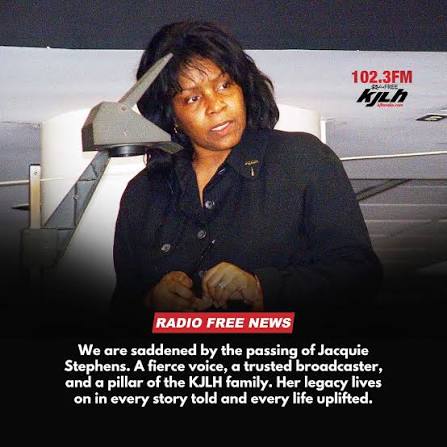
Remembering Jacquie Stephens: A KJLH Journalist Who Served Los Angeles When It Mattered Most
Former KJLH colleagues remember longtime journalist and public affairs leader Jacquie Stephens as a trusted broadcaster, consummate professional and pioneering voice who understood the responsibility of serving her community.
For generations of Los Angeles radio listeners, Jacquie Stephens represented what community broadcasting was supposed to be: informed, professional, engaged and connected to the people the station served.
Stephens spent more than two decades at 102.3 KJLH in Los Angeles, becoming one of the station’s most respected journalistic voices and eventually serving as News and Public Affairs Director.
But for those who worked alongside her, the titles tell only part of the story.
They remember a journalist who understood the responsibility that came with being behind a microphone, treasured the credibility she earned with listeners and treated service to the community as an essential part of the job.
The Choice Was Easy
Carl Nelson, who brought Stephens to KJLH from KDKO in Denver, remembers recognizing immediately that she possessed a combination of broadcasting skill and serious journalism that set her apart.
“I brought Jacquie Stephens to KJLH from KDKO in Denver. The choice was easy because Jacquie was the complete package—not only a great broadcaster but also an accomplished journalist, a rarity in broadcasting these days,” Nelson recalled.
“Jacquie had an innate ability to decipher information and make it relatable to our audience. She understood her role as a Black broadcaster and recognized the importance of delivering accurate, timely information.”
That commitment to credibility became one of the defining characteristics of Stephens’ career.
“Listeners trusted her, and she treasured her credibility as a serious, respected journalist,” Nelson said.
His recollection also points to a legacy that continues beyond the microphone.
“Though her voice may be silenced, Jacquie Stephens’ legacy lives on through her brainchild, the annual KJLH Women’s Health Forum.”
A Journalist in the Newsroom During a Historic Moment
Lee Michaels, who served as KJLH’s COO and Program Director, worked with Stephens during one of the most consequential periods in the station’s history: the Rodney King unrest in Los Angeles.
“While working at KJLH in Los Angeles as the COO and Program Director, I had the pleasure of working with Jacquie Stephens,” Michaels recalled. “She was a part of our newsroom during the Rodney King unrest. She was dedicated and a top-notch journalist. She, like others, stayed at the station for countless hours to ensure we covered the activity that was going on in Los Angeles. A true professional.”
When Los Angeles erupted following the April 29, 1992 verdicts in the trial of four police officers charged in the beating of Rodney King, KJLH abandoned its regular music programming and commercials and devoted its airwaves to news, information, conversation and community service.
The station’s coverage would ultimately earn KJLH a George Foster Peabody Award.
For those inside the station, however, the recognition came later. The immediate concern was serving a frightened and often information-starved community while events were unfolding around them.
Stephens was among the journalists who helped fulfill that mission, putting in the long hours necessary to make certain KJLH listeners had timely, reliable information during an extraordinary moment in Los Angeles history.
“Class and Professionalism Every Single Day”
Eric “Rico” Reed, a former KJLH air personality, remembers Stephens from their years together at the station beginning in the 1980s.
“I remember when Jacquie joined us back in the early ’80s. She was smart, well-read and a consummate professional with everything she did,” Reed said.
“I had the pleasure of working with her as my afternoon drive newsperson, and she brought class and professionalism every single day, both on and off the air.”
Reed remembers Stephens as much for the person she was away from the microphone as for the broadcaster listeners heard on it.
“A true Queen, in every sense of the word. You’ll truly be missed, my friend. God bless you, your family and your daughter Stayjah. Jacquie Stephens — a true radio pioneer and a blessing to the entire community.”
More Than a Newscast
Stephens’ career at KJLH extended well beyond delivering the news.
She became closely identified with the station’s public affairs programming and its connection to Los Angeles’ Black community. Her work reflected a philosophy of local radio in which broadcasters were not distant observers of the communities they covered. They were part of them.
Nelson’s description of Stephens’ ability to take information, understand it and make it relatable to KJLH’s audience goes to the heart of what distinguished her work.
She understood that accuracy and timeliness were fundamental to journalism, but she also understood something equally important: information had to mean something to the people receiving it.
That commitment could be heard during extraordinary events such as the Rodney King unrest, but it also showed itself year after year in Stephens’ coverage of issues affecting families, neighborhoods and organizations throughout Southern California.
Perhaps no example better demonstrates that commitment than the KJLH Women’s Health Forum.
What began as Stephens’ vision grew into an annual community institution serving thousands of people and addressing health issues of particular importance to women and families.
It was another expression of the philosophy that defined her journalism: identify a need in the community and use the power of broadcasting to do something about it.
A Radio Legacy Worth Remembering
At a time when local newsrooms have disappeared from many radio stations across America, Jacquie Stephens’ career is also a reminder of what can be lost when radio separates itself from the communities it is licensed to serve.
She represented an era — and a standard — in which a radio journalist knew the community, understood its concerns and earned the trust required to tell its stories.
Carl Nelson saw those qualities when he brought her from Denver to Los Angeles.
Eric “Rico” Reed experienced them working beside her every afternoon.
And during the Rodney King unrest, Lee Michaels saw those qualities tested under extraordinary circumstances as Stephens and her colleagues remained at KJLH for countless hours serving a city in crisis.
Different memories. Different moments in her career.
But each points to the same Jacquie Stephens.
A journalist.
A broadcaster.
A professional.
A pioneer.
And, most importantly, a trusted voice in the community she served.
Her voice may now be silent, as Nelson said, but her work continues to speak — through the journalists and broadcasters who worked beside her, through the listeners who trusted her and through the KJLH Women’s Health Forum that carries forward a vision she helped create.
That is a legacy measured not simply in years behind a microphone, awards or job titles.
It is measured in trust.
Jacquie Stephens earned that trust.
Radio News Now extends its condolences to Jacquie Stephens’ family, friends, former colleagues and the generations of listeners whose lives she touched.
Remembering Jacquie Stephens: A KJLH Journalist Who Served Los Angeles When It Mattered Most